
"Silence Is a Slow Erasure": The Webinar with Dr. Ezzideen Shehab and Prof. Dana Amir
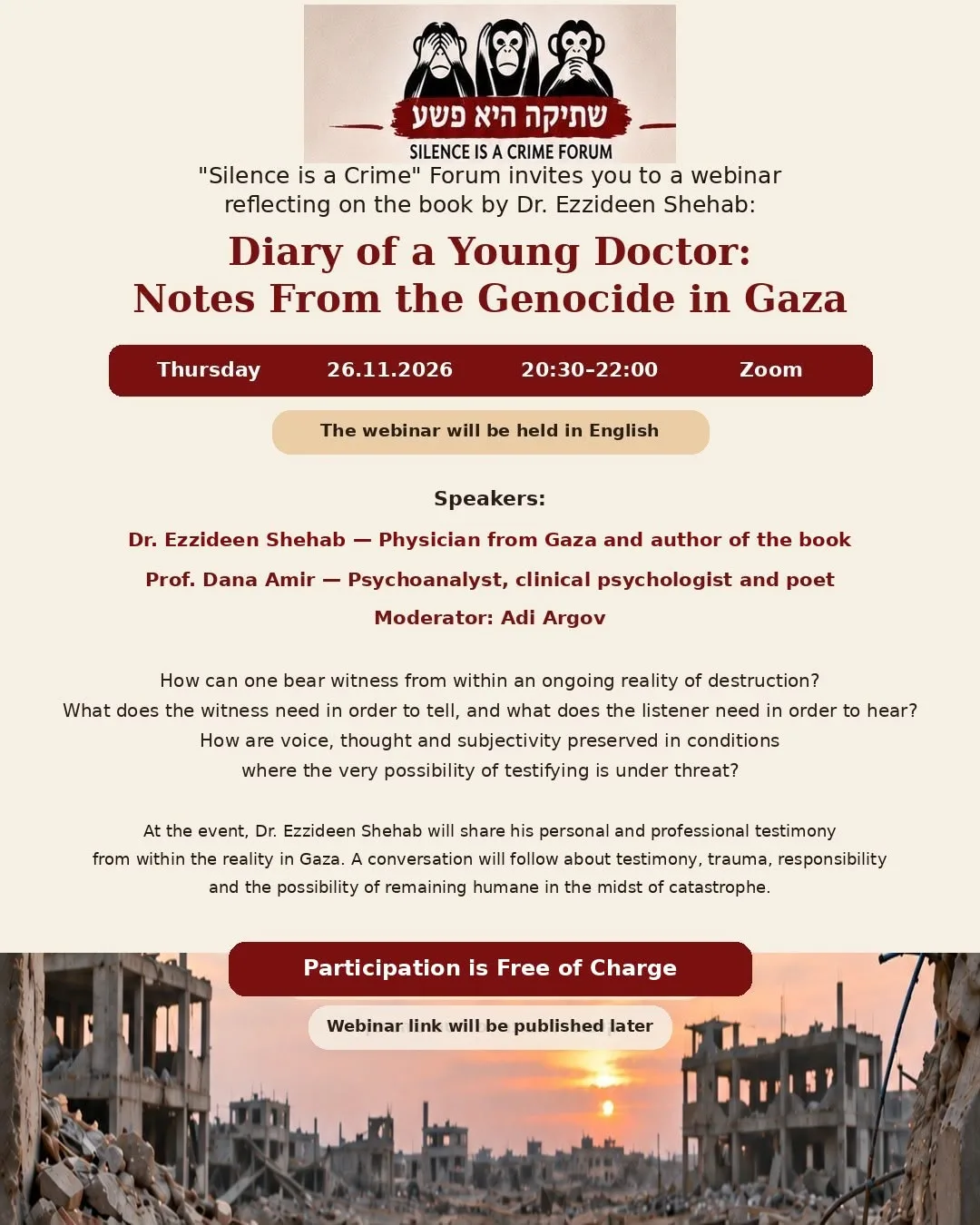
On Thursday, 26 November 2026, the "Silence is a Crime" forum held a webinar (on Zoom, in English) marking the publication of Diary of a Young Doctor: Notes From the Genocide in Gaza by Dr. Ezzideen Shehab, a physician from Gaza. He was joined by Prof. Dana Amir, psychoanalyst, clinical psychologist and poet; the conversation was moderated by Adi Argov.
The questions at the heart of the evening: How can one bear witness from within an ongoing reality of destruction? What does the witness need in order to tell, and what does the listener need in order to hear? How are voice, thought and subjectivity preserved in conditions where the very possibility of testifying is under threat?
Below are Dr. Shehab's remarks at the webinar, Prof. Amir's response, and, to close, a passage from the diary, from April 2025, which we bring here in his own words.
Dr. Ezzideen Shehab's remarks
Hello everyone,
I am glad to be here with you. You have chosen to listen to someone to whom these things happened. I thank you for that. There were nights in Gaza when I would have given a great deal to know that somewhere there was a person willing to hear me. Now I find myself in a room full of such people, and the curious thing is that I hardly know how to begin.
My name is Ezzideen Shehab. I am a doctor. I was born and raised in Jabalia, in the northern Gaza Strip, in a family of modest means. In 2013, I finished high school with very good grades. My family was proud of me. We also knew exactly what we could afford. University was beyond our means, in Gaza as well as abroad. If I was to become a doctor, I needed a scholarship.
Eventually, I received one.
On December 16, 2013, I crossed the border into Egypt to study medicine abroad. It was my birthday. At that age, this detail seemed to me of the greatest importance. Of all the days on which I might have left home to begin my life, it had been arranged, so I thought, that I should leave on the very day I had come into the world. I believed in justice and goodness. I believed things happened for a reason. And if the reason was occasionally difficult to discern, well, one had only to live a little longer and it would become clear.
I took it as a sign of a new beginning. I was almost being born again.
For more than nine years, I did not see my family. The crossing between Gaza and Egypt was often closed. Whether a student could go home to visit his mother and afterward return to his studies depended on relations between the Egyptian authorities and Hamas. My family was afraid that if I came back, I might never get out again. So we agreed I would finish my education first. We missed one another, and because we missed one another, we took great care to persuade one another that I ought to stay away.
I finished medical school. I wanted to pursue specialist training in Germany. First, though, I was going home. My family had waited long enough to see their doctor.
I arrived very late on October 4, 2023. They were all still awake.
There were children I had never met. They had been born while I was away, and here they were, already old enough to remember a life in which I had never appeared. Then there were the boys I remembered. I had to look up to see their faces. How strange it is to discover that you have kept a boy small for years in your thoughts and that, quite independently of you, he has become a man.
I wanted to know them as they were now. There was so much to ask that I scarcely knew where to begin. Well, I thought, there would be time.
What I remember best is how happy they were. I had been the one to sit the examinations, but anyone who saw my family that night would have understood that we had all graduated. I had known my success belonged to them too. What I had waited nine years for was to see it on their faces.
Three days later, on October 7, the war began. I had come home to celebrate my graduation. I became a witness to and a victim of what I believe will remain one of the greatest stains on modern history. Those three days were the last days of happiness my family would know.
The next day, we began moving from place to place, looking for somewhere safer. On October 12, eight days after I came home, the Israeli army bombed our family home.
Forty-two members of my family were killed. My grandmother, my aunts and uncles, more than twenty children.
I have just said "my grandmother." That is who she was to me. But there was my mother, and it was her mother who had been killed. Her sisters had been killed too. I had come home so that my mother could see me as a doctor. Eight days later, I was beside her, trying to think what a son could say to his mother about the death of her mother.
And here I am now, trying to tell you about them in two minutes. I have told you how many were killed. There is time, perhaps, to tell you something about the children. It seems a small enough thing to ask of someone who belonged to their family. Tell us something about them. What were they like?
That is what I had come home to find out.
There are details of those days that I could spend the rest of our time describing, and by the end of it you would still know very little of the forty-two people who died. What they hoped for, what troubled them, what the children might have become. I do not know how anyone comes to understand such a loss. I think you might spend your whole life trying.
For a long time afterward, I felt as though I were watching what happened to us from a little distance. I could see this young man who had come home to celebrate with his family. I could see that his mother needed comforting. I felt terribly sorry for him. Then a decision had to be made, and it turned out that I was the one who had to make it.
I had to persuade my father to leave our home, to take two small bags and come out into the street with me. And where did I propose to take him? I did not know. I had to persuade him all the same.
In the mornings I went through the markets looking for a little cheese or some flour. A few days earlier, I had been thinking about what sort of specialist I might become. Now, if I could find enough for my family to eat that day, that was a morning well spent. Even going to the hospital seemed a luxury. So did writing. If I used the battery on my phone to write, how would we see after dark?
Besides, where was I to sit? I had no privacy, no quiet place. I sometimes thought that if I could have just a few minutes alone, I would write down what had happened to us. To be quite honest with you, if I had found those few minutes, I think I would have spent them crying.
After some months, I went to the hospital. I wanted to help someone. There was also the hope, which I understood less clearly at the time, that someone might need me badly enough to give me a little peace from my own thoughts. I had been trying to understand what had become of my life. A person in pain could at least tell me where it hurt. There might still be something my hands knew how to do.
I had only just graduated. There were nights when I was the only doctor on duty in the emergency department. On an afternoon shift I might be the only doctor covering both orthopedics and the emergency department. Consider what that means for a moment. Two people need you. You have the knowledge to help them both. Which knowledge are you to use to put yourself in two places at once? Go to one and the other must wait. And it is you who must decide which one waits.
There was so much screaming. I would come home to my mother with my clothes covered in blood. The next day I put on my clothes and went back.
Sometimes, after two in the morning, things grew a little quieter. I would sit outside the hospital entrance. It was terribly cold. I could hear the aircraft overhead. After all the cries I had heard inside, it was there, in those few minutes of quiet, that I felt such a need to scream myself.
I could not scream. So I began to write.
At first, what I wanted to say was very simple. We are here. This is happening to us. Is there anyone there who understands that it is happening?
I knew what I had seen. I had taken the blood home on my clothes. Yet I needed someone who had never met us, someone quite beyond the reach of my voice, to acknowledge that we existed. Everything I had believed about the world had fallen apart. I thought that if someone could hear us, perhaps I might begin to understand the world again.
After October 7, I heard the words "human animals" from the highest levels of the Israeli government. I began to fear that this was how much of Israeli society saw us, and much of the world too. At the time, it was the only explanation I could find. If people saw us as we saw one another, how could they watch what was happening and do so little to stop it?
I wanted to write about the color of our children's blood. That is an extraordinary thing for a doctor to want to explain. What color should a child's blood be? It was red. Anyone who had ever seen their own child bleed would have recognized it. I wanted someone to hear a father in Gaza at the moment he learned his child was dead. Suppose you heard him from the other side of a door. What would there be in his cry to tell you whether the father behind that door was Palestinian or Israeli? You would know that a man had lost his child. You would know before anyone told you.
I wanted to write about the women screaming as they searched for their children. About the voices of fathers who had just learned their families were gone. Our mothers grieved. Our children felt pain. We loved the people we were losing. I found myself sitting outside a hospital trying to explain these things to my fellow human beings.
Perhaps a photograph went by too quickly. Perhaps someone who had seen the videos still needed to hear from a person who had been there. If I wrote down exactly what I saw, someone might read it and understand why I needed to scream. That was my hope when I began.
Later, after the hospitals in northern Gaza were forced to stop operating and the healthcare system had almost entirely collapsed, I opened a small clinic. We provided free medical care to people who had nowhere else to turn.
At the clinic I had time to ask a patient another question and to stay long enough to hear the answer. I began to notice a sadness in people's eyes, a kind of emptiness so familiar that at first I thought I understood it. We had lived through the same war. I knew what it was to lose your home, to look for food, to fear for the people you loved. Then the person sitting across from me would begin to speak, and I would discover how little I knew about the sadness in those particular eyes.
I could have made the same mistake with my own mother. We had both lost the same woman. I had lost my grandmother. My mother had lost the person she might once have gone to for comfort when her sisters died. I was her son, I loved her, I was there beside her, and still there was a part of her grief I could only come to know if she chose to tell me.
It was like that with my patients. Every one of them had a story of their own, and most of those stories would never make the headlines. There was little in them about negotiations or military operations, little that a politician would think to mention. There was a great deal about whom a person loved. About what it cost them to go on hoping. About what happened to them when they found they could no longer hope for the one thing that had got them through the day before.
I had used the words "the war" as everyone uses them. In the clinic I began to understand how many lives I had gathered into those two words. There were millions. I could spend an afternoon listening to one person and still have a question I wished I had asked.
So I began writing their stories too. I wanted people beyond Gaza to know what had happened to the person who had sat across from me that day and what it meant to that person to go on living. And I had a reason of my own. At the end of the day, I went home with their faces and names still in my mind. Sometimes I felt I could hardly bear to carry another story. I wanted someone to help me remember.
I thought of a reader coming across a patient's name. Perhaps, later that evening, they would tell someone else what they had read, and in telling it they would say the name aloud. I liked to think of that. Somewhere far from Gaza, two people would know the name of a person they had never met. Even if that life had been taken, there would still be someone to remember whose life it was.
In the beginning, I wrote because I needed to scream. Later, I wrote because people had sat down across from me and told me who they were. I could not bear the thought that they might disappear and the world would never know whom it had lost.
There is one thing I still struggle with, and since you have been willing to listen to me this far, I would like to tell it to you plainly.
When I sat outside the hospital, I believed that our great difficulty was to make ourselves heard. It was a terrible thought that perhaps no one could hear us, but there was some hope in it. I could write another page. I could tell the story more faithfully. Somewhere there was a person who would act as soon as they understood. I had only to find the words to reach them.
But there were photographs. There were videos. There were people giving their names, showing their faces, asking quite plainly for help. Day after day we told the world what was happening. And the world did hear. The suffering continued.
I still think of that young doctor sitting in the cold, trying to find the right words. What if there was nothing wrong with his words? What if the person he was trying to reach had read them, understood precisely what he meant, felt sorrow for him, and then gone on with their day?
I began by thanking you for listening. I meant it. I remember too well what it was to sit outside that hospital and long for a listener. And now that you are here, there is something I would like to ask you, something the man I was then had scarcely dared to ask himself.
When you close the book, turn off the screen, or leave this room and go home, what responsibility goes home with you?
That is what I hope we can talk about together today.
"His Hope, Our Responsibility" — Prof. Dana Amir
In August 2025, I joined the forum "Silence is a Crime", which was designed to protest the Israeli mainstream media's consistent silencing of the humanitarian disaster in Gaza and demand that a voice be raised against the killing and starvation. In the first demonstration organized by the forum, a letter written by a Gazan doctor named Dr. Ezzideen Shehab was read aloud. It was the first time I heard his name. Since then, I have followed every word he has written. There is no greater gift than the opportunity to address his beautiful writing here this evening.
In his book Remnants of Auschwitz, the Italian philosopher Giorgio Agamben quotes Hermann Langbein, an Austrian historian and Auschwitz prisoner, who wrote:
"For my part, I firmly decided that whatever happened, I would not commit suicide. I wanted to see everything, to live through everything, to experience everything, to preserve everything within me. To what end, since I would never have the possibility of shouting to the world what I knew? Simply because I did not want to remove myself from the way, I did not want to eliminate the witness I could become."
Ezzideen Shehab places himself in a similar position: he seeks to separate the witness of flesh and blood, who may not survive the next bombing, from the witness who observes things beyond the outlines of his private survival, not only "under the rubble" but also "beneath history": the witness who insists on sketching the contours of the history that threatens to erase him.
But his book does not bear witness only to the historical catastrophe. It also bears witness to the possibility of preserving a human horizon even when humanity itself is being trampled in every imaginable way.
In Latin, writes Agamben, there are two words that correspond to the meaning of the word "witness". The first word is testis, which etymologically denotes one who places himself as a mediator, as a third party in a conflict between two sides. The second word is superstes, which means "one who has gone through something to the very end, and can therefore provide testimony."
Ezzideen Shehab indeed positions himself in both these stances: the stance of one who is going through something to its very end—and the stance of one who mediates, for his readers as well, between hell and language.
In my work on traumatic testimony, I identified four testimonial modes, differentiated from one another by the degree of psychic mobility they are able to maintain in relation to traumatic events. The most developed testimonial mode is the one in which it remains possible to hold two positions simultaneously: the "experiencing I," situated within the event, and the narrating "I," which observes the event from outside; the position of the victim along with the position of the witness.
Ezzideen Shehab's notes struggle throughout to preserve precisely this mobility. The trauma about which he writes is not behind him. He writes from within it. The home is lost while he is writing; members of his close family are killed while he is writing; the hospital ceases to be a hospital while he is writing; food and water disappear while he is writing. There is no longer any stable distinction between the doctor and the wounded he treats. The doctor himself is hungry, displaced, grieving, under threat. He sutures the wounds in other people's bodies while his own biography is being torn apart.
In this sense, his testimony takes place while the "experiencing I" is still wholly immersed in the experience itself. And yet, time and again, his writing brings into being an "observing I" that turns the unbearable into a melting pot of language and insists on addressing a possible addressee to whom that language might speak.
The concept of the traumatic lacuna refers to the blank spot, the void, within traumatic experience. It is that zone of experience that cannot be transformed into memory. Ezzideen Shehab's notes mark innumerable such lacunae. But his writing does not merely mark the lacunae within the writer's own experience; it also addresses the possible lacunae within the reader.
"Suffering demands to be witnessed," he writes, and elsewhere: "silence is a slow erasure."
Over the past three years, Gaza has become an isolated enclave of hell, an "event without witness," to use the term of the psychiatrist and psychoanalyst Dori Laub — an event in which the refusal to name what is happening participates in the question of whether it is happening at all. Ezzideen Shehab's notes struggle precisely against this: they insist on giving a name to what might otherwise be erased from the pages of factual history and, worse still, from the pages of moral and emotional one.
The ability to emerge from catastrophic situations resembles the ability to emerge from beneath rubble. It depends on the capacity to imagine, in the mind's eye, a route of escape — a hand reaching toward us precisely at the moment when reality itself urges us to give up.
It is the power to move beyond actual reality toward a possible one. This power does not merely enable us to bear actual reality; it is also the condition that prevents actual reality from drawing the final line.
Ezzideen Shehab's ability to trace, from within the inferno, the outline of a possible human addressee to whom one can cry out is his heroic way of transcending actual history toward a possible one. I cannot imagine a greater act of resistance, nor a greater act of hope. This hope is our responsibility.
From the diary: April 2025
The night did not fall. It broke. A sound tore through the silence, not like thunder, but like something deeper collapsing, something within the world itself. News came: an entire residential block crushed into dust.
We ran. We didn't speak. There was no room for thoughts, no space for hope. We moved patients from beds to chairs, from chairs to floors. Anything to make space. The ER transformed into a corridor of shadows.
And then, they came. Waves.
Ambulances screeched like some beast in agony. Doors slammed open, stretchers collided. Blood smeared across the floor, across the hands of the living. Screams echoed, not cries, but something more terrible, like truth made sound. People begged for names. Others wept without knowing what they'd lost.We treated the ones whose lungs couldn't hold air. Those whose blood refused to stay inside. Broken arms could wait. But death, death could not be reasoned with. It barged in. It took whoever was slowest to flee.
One man died while I held his hand. Still warm. I whispered something, I don't know what. I told security to take the body. We needed the bed.
I needed the bed.And then, the girl.
She was five. Curled on a bed like a forgotten doll. Not screaming. Not even speaking. Just a soft, continuous sob, like someone apologizing for being alive. Another doctor had checked her. Stable vitals. Left aside.
I passed again. She was still crying. Still no one with her.
"What's your name?" I asked.
"Dima Awad," she whispered.I shouted into the corridor:
"Whose daughter is this? Who is with her?"Silence.
I moved on. We all did. We kept moving. That's the horror, not the screams, but the fact that we move on. That we must. Time becomes something else. Something sick.
An hour passed. Then another. I returned to her. Still there. Still crying. I examined her, a fracture in the leg. Orthopedics came. Still no name. No family. Someone called neighbors of the Awad family. No one recognized her.
Three hours passed. Then a young man came with lab results.
"You asked for these," he said.
"I don't know the patient," I replied.
He pointed to her. Her name was Lana Muqbil.Her whole family, gone. Mother. Father. Brothers. Aunts. Uncles. All of them. Vaporized. Not even remains to identify. Just dust and a name she barely knew how to spell.
The young man? Not even a cousin. Just a neighbor. He remembered her face from somewhere. And because the dead were beyond help, he sat beside the only one who was still breathing.
This is Gaza. This is what war truly is.
Not the speeches. Not the maps.
But a child sobbing in a corner, surrounded by people who are too busy keeping others alive to sit and hold her hand.This is not strategy.
This is not defense.
This is a mechanism of destruction, cold, calculated, eternal.
It eats memory. It devours names.It is the silence after a child says her name and no one replies.