
This essay was born out of an ongoing experience of daily, unceasing contact with the human intolerable, and with the edges of what can be contained under the title “human.” It is customary to think of the intolerable as that which, by its very nature, challenges thought and language. What words can be given to it? But that is precisely the point: the words, or the language, in which the intolerable we are speaking about today is formulated, matter a great deal. The ways in which language masks – and at the same time licenses – what we are witnessing here are tremendously significant.
I would like to begin not with language, but with silence: with looking away, averting one’s gaze, deafness, muteness – even before the silencing that comes from the outside. “Silence must be understood and judged from a moral point of view,” writes Natalia Ginzburg in an essay entitled “Silence[1].” “Silence can bring about a turbid, monstrous, diabolical misery. […] It can bring about death.”
Why is silence a matter of ethics or morality? How can silence bring about death?
What emerges from these sentences of Natalia Ginzburg is that silence is not a non‑action but an action. It is not non‑speech, but a kind of speech, even a kind of commandment, and at times it is more disastrous than speech itself. Speech is overt – and therefore its boundaries are clearly marked. Silence, by contrast, is transparent. It is formless and therefore boundless. It is a kind of spreading, malignant disease, precisely because it sends out metastases without declaring itself. Its passivity is its power. Passivity, like victimhood, is an immense power. And this power accumulates.
When Dori Laub coined the term “event without a witness,” he meant that the most traumatic zones in human history and in psychic biography are the zones in which the rupture received no recognition and therefore was never fully known. “An event without a witness,” writes Dori Laub, is a situation “which precluded the possibility of imagining an other. There no longer was an other to whom one could say ‘Thou’ in the hope of being heard, of being recognized as a subject, of being answered. […] And when an appeal to the other is no longer possible – you cannot say ‘Thou’ even to yourself” (2008[2]).
But that moment in which one person is seen by another does not only make present the one who is seen – it also makes present the one who sees. The call “Here I am” (Hineni) is not directed only outward, toward the other – it is also directed toward ourselves. In contrast, the moment in which we look at the suffering of the other “with our eyes wide shut,” and fill our mouths with water, is a moment in which we do not only annul that other – we are also humanly diminished. We become those who cannot say “Thou” even to themselves. That is why they who guards their soul “will draw near”, as the title of this webinar indicates, and not “stay away”.
Now I come to language, and to the way it turns from something that marks moral boundaries into something that blurs moral boundaries.
The French philosopher Jean‑François Lyotard (1989[3]) argues in his book The Differend that what constitutes “the perfect crime” is not the murder of the victim or the elimination of the witness, but the transformation of the witness into one who is mute, the transformation of the judge into one who is deaf, and the rendering of the testimonial text incoherent. If the witness is blind, the judge deaf, and the content of the testimony fragmented and devoid of sense – the crime is not recorded and therefore, ostensibly, has not occurred at all.
The scene Lyotard describes is a scene whose various elements characterize both the language of the individual perpetrator and the language of the collective one. It is a language from which any kind of turning of the gaze outward or inward has been omitted; a language that erases the very deeds it describes and renders them transparent.
The national discourse grounded in this language is a discourse led by an effort to whitewash, launder, dissolve its own meaning: a terrible, bloody war is formulated and delivered to the public as a war of liberation destined to bring eternal peace; prolonged abuse and harassment are sold as acts of no‑choice, as military necessary procedure, as deeds carried out in self‑defense or to protect public safety. The habituation to all this, the accommodation to all this, are sold to the public as resilience. There is no end to the distortions that language distorts, and to the ways in which it undermines meaning instead of pointing to meaning, robs us of understanding instead of creating a link to the possibility of knowing.
George Orwell, in his book 1984[4], offers a concept that is more relevant to us today than ever: “Newpeak.” Orwell’s book, written in 1949, is a vision of the year 1984. Its protagonist lives in a totalitarian state in which the citizens are under the watchful eye of “Big Brother,” the Party’s ruler. History is rewritten according to the needs of the leadership, and language turns into a language that constrains the citizens’ capacity to think. The goal of the “Newpeak” is to reduce the vocabulary, to eliminate certain terms from it, to transform language from something that enables and expresses thought into something that constrains it. Language ceases to be the citizen’s language and becomes the language of the authorities, who determine for the citizen what he is and is not permitted to think about.
I am using the term “Newpeak” today not in order to point to the ways in which citizens’ discourse is limited by the regime – although that is more relevant and timely than ever – but in order to point to the ways in which the discourse of all of us is limited by what we are willing to know about ourselves.
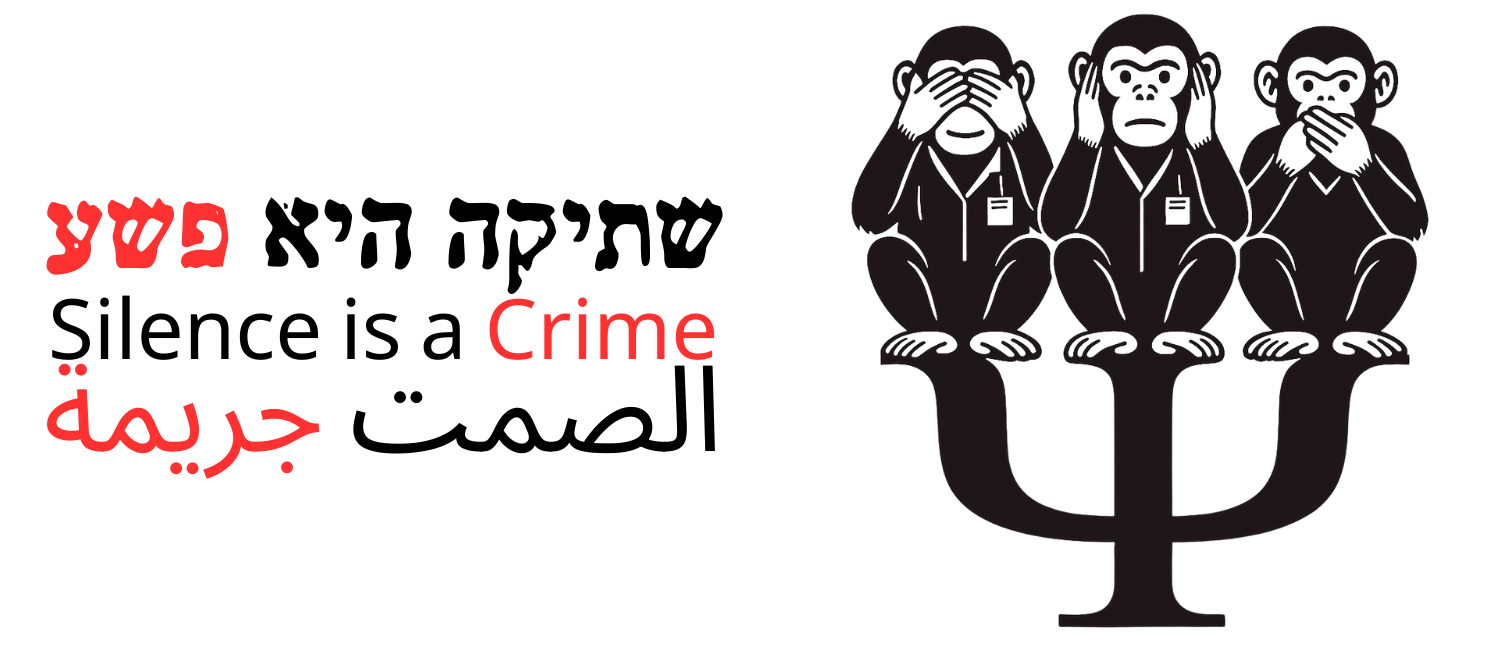
This courtroom scene that Lyotard describes – the scene composed of the mute witness, the deaf judge, and the incoherent testimony – is reminiscent, not coincidentally, of the image of the three monkeys covering their eyes, ears, and mouth, which is the logo of the forum “Silence Is a Crime,” founded for precisely the reasons that brought us together here. But this is not only an external scene; it is also an internal one. Each of us, confronted with the atrocities perpetrated in our name, is tempted at moments, or for more than moments, to become a mute inner witness, a deaf inner judge, a text devoid of sense. It is not easy to look with eyes wide open not only at the horrific suffering of the other, but also at our collaboration with this suffering.
But that is precisely the point: the moment we become mute and deaf, the moment we allow the suffering to remain meaningless, we are not only collaborating with the obscuring of that suffering – we also become responsible for its continuation. In Lyotard’s terms, through our silence, both toward others and within ourselves, we allow the crime not to be recorded and therefore to appear as if it never took place.
Orwellian Newpeak creates an environment in which language does not mediate between the person and his experiences, but severs him or her from them. It is a language that leaves out of the story not only the victims but also the perpetrators, and in a certain sense all of us, because it turns the scene into one in which there is no kind of reckoning: not of the person in relation to others, and not of the person in relation to him or herself. There are no witnesses, no judges, no complaint that has any meaning. This is the slogan of this period: “Nothing happened, and therefore nothing will happen.”
If the disease is the splitting of language – the only way to create a ground for healing is the reclamation of language. Reclaiming language means reclaiming the function of the inner witness (Amir, 2012)[5], the function of the inner judge, and the meaning of the testimonial text; it means restoring the connection between the manifest and the latent content, between words and emotional experience; it means reclaiming not only the story but also the narrator: insisting on a language that does not erase the speaker but rather constitutes him as an Archimedean point – that is, making him or her into the sole fulcrum by means of which they can lift themselves, by their own strength, out of the moral abyss in which they are trapped.
[1] In: Ginzburg, Natalia. The Little Virtues. Translated by Dick Davis. New York: Arcade, 1985. E-book.
[2] Felman S, Laub D (1992). Testimony: crises of witnessing in literature, psychoanalysis, and history. New York and London: Routlegde.
[3] Lyotard, J.-F. (1989) The Differend: Phrases in Dispute. (Theory and History of Literature, Vol. 46). Translated by G. Van Den Abbeele. University of Minnesota Press.Orwell., G. (1949). 1984. London: Secker and Warburg.
[4] Orwell, G. (1949). 1984. London: Secker & Warburg.
[5] Amir, D. (2012). The Inner Witness. The International Journal of Psycho-analysis, 93:879–896.