
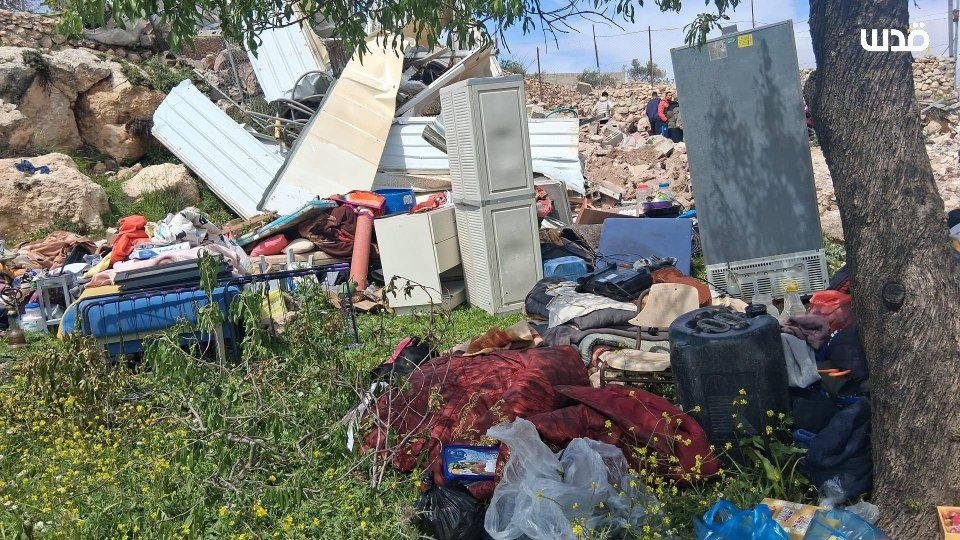
*Photo: Khirbet Ma’arjam. Duma. 23.3.26
I think of the hundreds of thousands of destroyed, abandoned, shattered homes — in the Gaza Strip, Lebanon, Iran, Israel, and the West Bank.
Inside each home: toys, photo albums, bed sheets still carrying the scent of love, damp towels from the last shower, pots left on the stove, handprints on the walls, shouts and quarrels absorbed into curtains. I think of the elderly, of people with disabilities, of those unable to flee in the bombarded north, trapped inside homes that may become their death trap. I think of disabled people carried on improvised carts in Gaza, led by family members together with piles of blankets and mattresses under evacuation orders, before their homes are bombed. I think of shepherding communities expelled from their lands.
When a house is destroyed, it is not only a structure that is lost. What is damaged is the most basic possibility of feeling held in the world. What should have allowed rest, dreaming, and continuity suddenly becomes testimony to rupture.
The destruction of homes is also an attack on the possibility of psychic existence itself: on the capacity to hold time, memory, play, and belonging. What was most intimate and familiar becomes strange, threatening, unrecognizable — “uncanny,” in the language of Sigmund Freud, but in truth also unhomed: no home. A home that existed and is no more. A bed exposed beneath an open sky, a toy in the dust, a wardrobe standing without a wall — all are testimony to the moment when violent exteriority entered what should have remained protected, crossing a boundary that should have remained intact. The wall breaks, and the psychic envelope cracks with it.
A displaced woman in Gaza says: “What separates me from the street is only the plastic sheet of the tent.” Bodily intimacy is repeatedly violated. Early psychic life depends on the existence of a holding environment — a space where one can lay down the body, release vigilance, and feel that the world will not suddenly collapse. In this sense, home is far more than walls: it is one of the material forms of that holding; a place where routine, smells, familiar objects, and everyday sounds build continuity and belonging.
When the holding environment is destroyed again and again, vigilance becomes an existential condition. Home ceases to promise safety, and may itself become a death trap burying both body and psyche.
Israeli leadership repeatedly promises a safe home to the residents of the north, and to all citizens: just let us flatten southern Lebanon, Gaza, Tehran — and security will return to your homes. Yet this promise repeatedly appears like a desert mirage: a soothing illusion for a psyche thirsting for a little quiet, the illusion that more destruction will finally generate protection.
Yet accumulated experience teaches otherwise: a home does not become safe through expanding destruction around it. On the contrary — as circles of displacement widen, the sense of security becomes more fragile, more haunted, more dependent on repeated force.
In Donald Winnicott’s terms, a stable holding environment cannot be built where millions live under constant threat of expulsion, bombardment, and loss of home. A holding environment is not created through denying the conditions of the other’s existence, but through creating conditions in which the other, too, can feel that life, home, and continuity are not revocable at any moment.
And therefore, no real quiet can be established here as long as one home rests upon the destruction of another. Only conditions that make a secure home possible for all who inhabit this region – can form the basis for a security that is not an illusion.
The image in this post is published in accordance with Section 27A of the Copyright Law. The website’s editorial team has made every effort to locate the copyright holders of the photograph. If you are the rights holder of this image, you may contact us for proper credit or to request its removal at: info@silenceisacrime.org